Corporate team building does not need to depend on lengthy presentations, awkward icebreakers, or activities that feel disconnected from the way employees actually work together.
A shared building challenge gives participants a clear objective and something physical to create. Teams must communicate, make decisions, divide responsibilities, adjust their plans, and solve problems within a defined amount of time. Because the challenge is visual and hands-on, participants can see the results of their collaboration immediately.
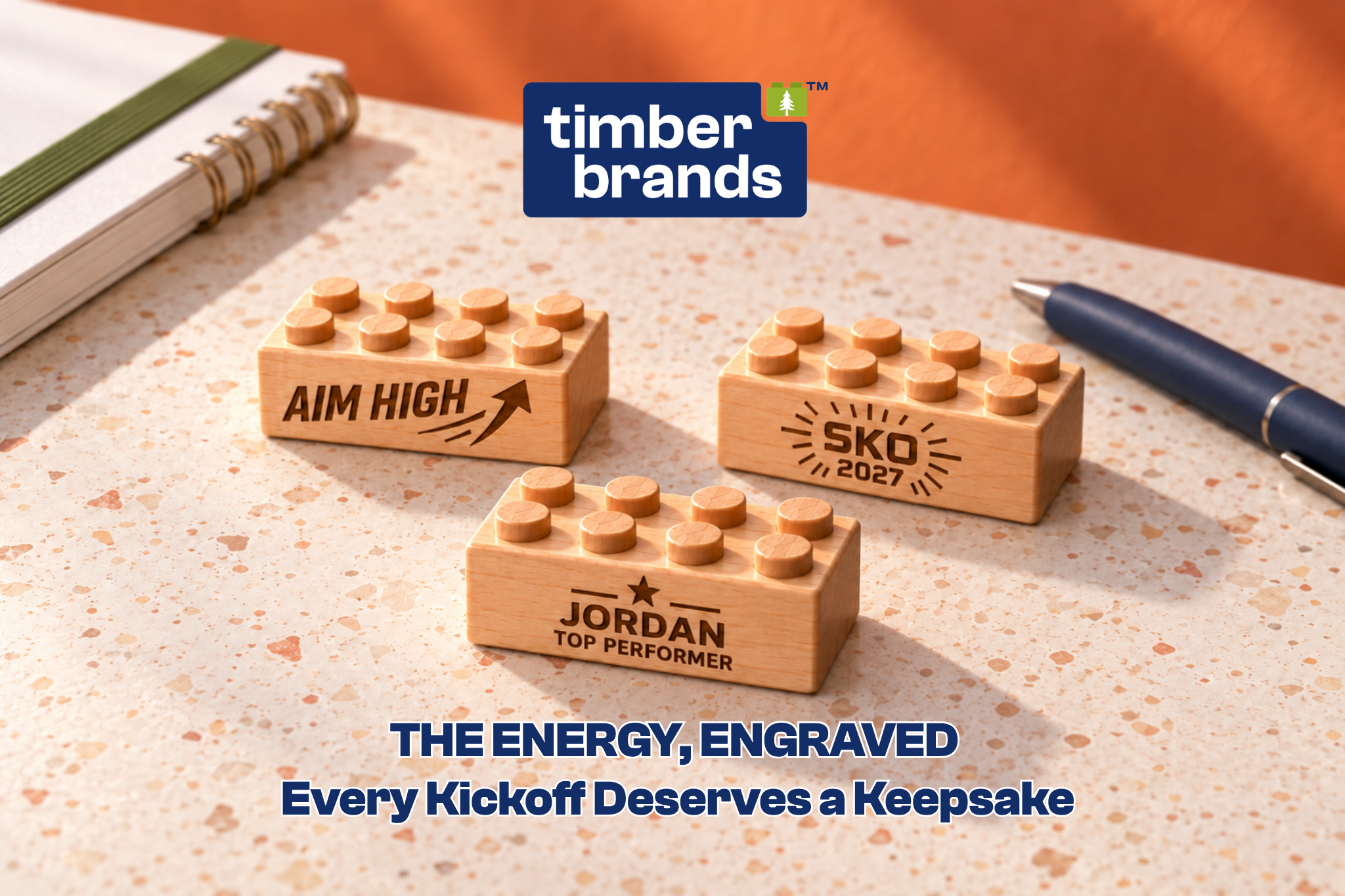
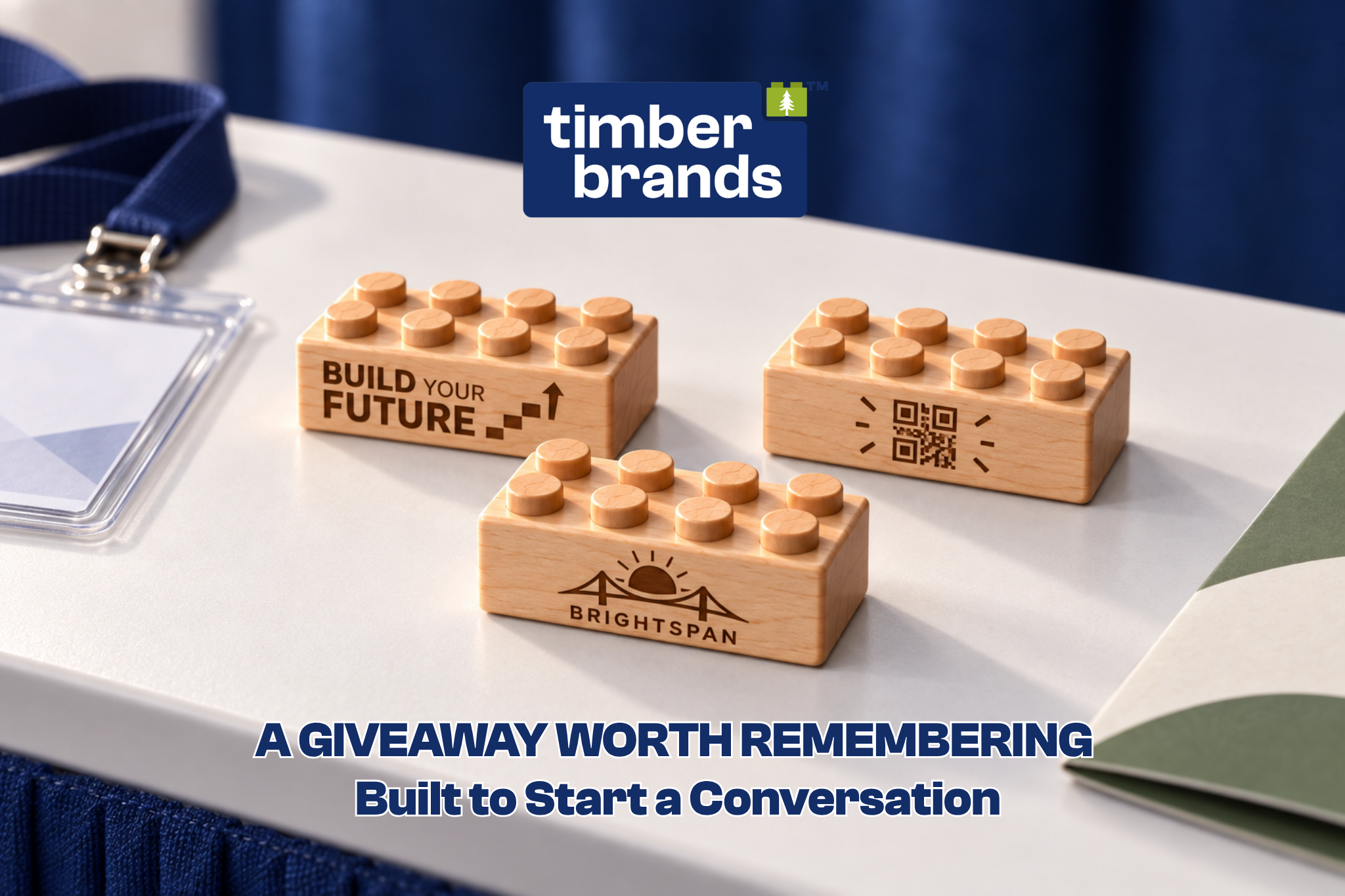
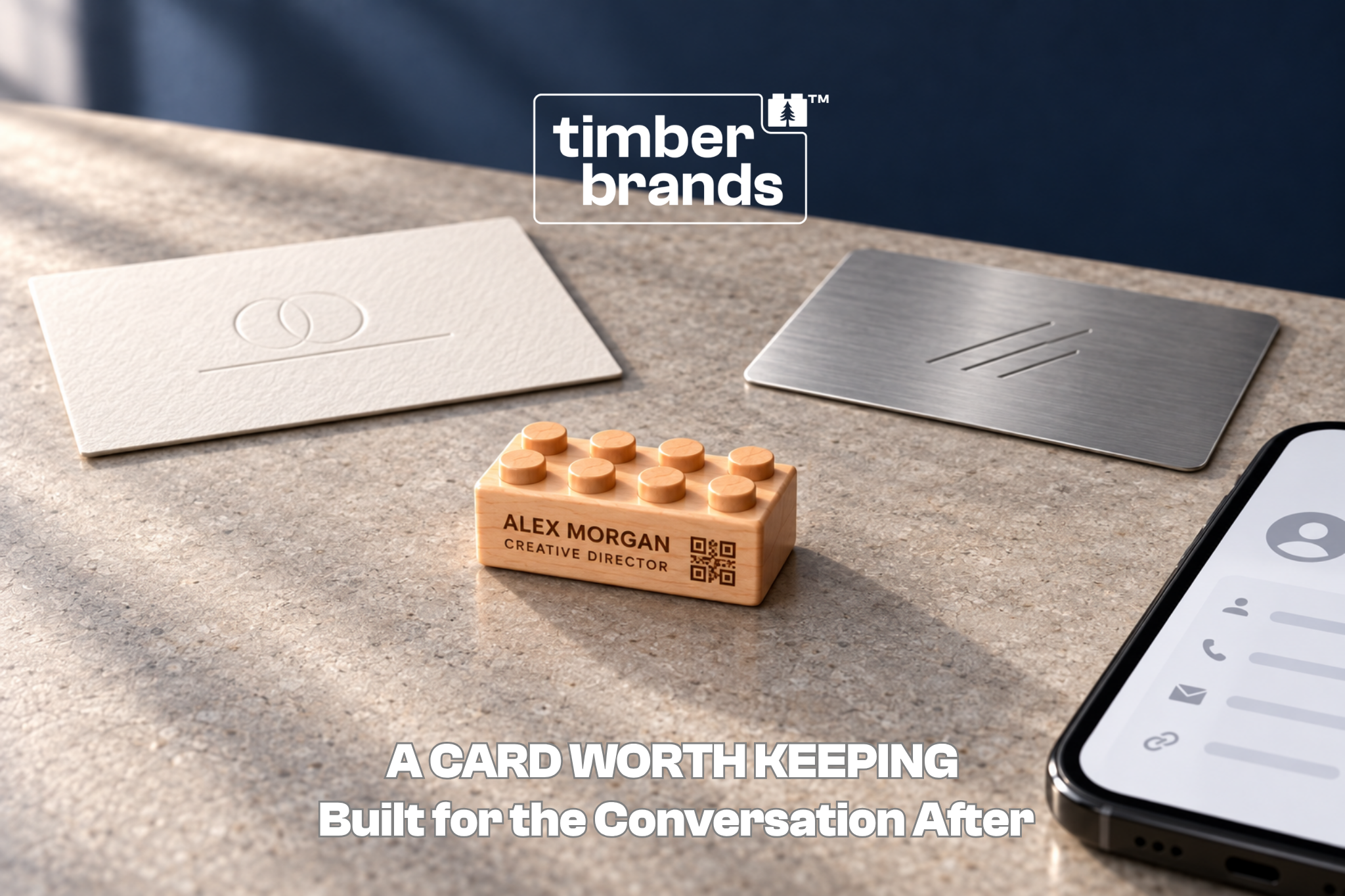
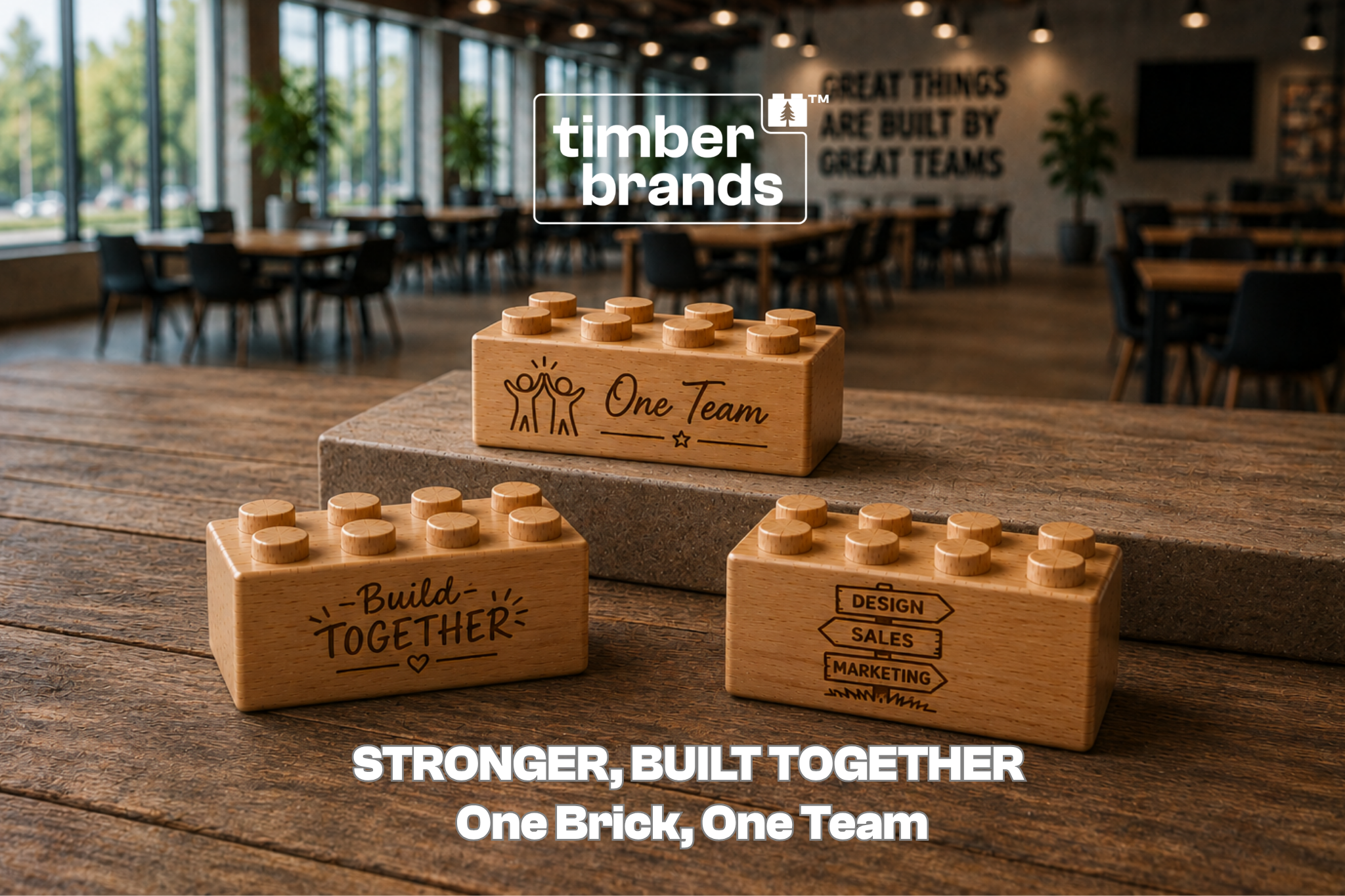
Timber Brands creates custom engraved wooden bricks that can be personalized with company values, department names, employee names, goals, products, or event themes. The bricks are precision milled from FSC-certified wood and permanently laser engraved in the United States.
Companies can use individual Standard 2×4 Wooden Bricks, coordinated custom wooden brick sets, larger Plus-Size Wooden Bricks, and wooden baseplates to create activities for small workshops, leadership meetings, employee onboarding, company retreats, and larger corporate events.
Timber Brands’ broader product platform includes personalized corporate sets, educational applications, interlocking bricks, figures, and baseplates that can support custom programs.
Why Do Building Activities Work for Corporate Team Building?
A physical building task gives a team a shared problem with a visible outcome.
Participants cannot complete the activity by listening passively. They must contribute ideas, ask questions, clarify instructions, negotiate priorities, and respond to the choices made by other team members.
The activity can also reveal workplace habits in a low-risk setting. One person may begin building before the group agrees on a plan. Another may ask strong clarifying questions. Some participants may naturally divide responsibilities, while others may wait for someone to take the lead.
These behaviors create useful material for the discussion after the activity. The finished structure matters, but the most valuable part is often understanding how the team reached the result.
Building exercises are also flexible. A facilitator can make the activity collaborative or competitive, structured or open-ended, brief or in-depth. The same materials can support communication training, leadership development, innovation workshops, employee onboarding, and company culture programs.
Quick Planning Guide
| Activity | Suggested time | Best for |
|---|---|---|
| Blind Build Communication Challenge | 20 to 30 minutes | Clear communication and active listening |
| Build the Company Values | 30 to 45 minutes | Culture and values discussions |
| Tallest Stable Tower | 20 to 30 minutes | Planning, delegation, and problem-solving |
| One Brick at a Time | 15 to 25 minutes | Collaboration and shared ownership |
| Replicate the Model | 20 to 30 minutes | Accuracy, process, and quality control |
| Build the Customer Journey | 30 to 60 minutes | Cross-functional alignment |
| Connect the Departments | 30 to 45 minutes | Reducing silos and improving cooperation |
| Innovation Prototype Sprint | 45 to 60 minutes | Creativity and rapid problem-solving |
| Change the Plan Mid-Build | 25 to 40 minutes | Adaptability and change management |
| Build the Shared Vision | 45 to 75 minutes | Leadership retreats and strategic planning |
The time can be shortened or extended based on group size, activity complexity, and the depth of the final discussion.
1. Blind Build Communication Challenge
The Blind Build Communication Challenge shows how easily information can be misunderstood when people cannot see the same thing.
Divide participants into pairs. One person receives a completed brick structure or an image of the model. The other person receives the loose bricks but cannot see the original design.
The first participant must describe the structure using words alone. The builder can ask questions, but the model must remain hidden until time expires.
After the build, the pair compares the original structure with the completed version.
The activity highlights the importance of clear instructions, shared terminology, active listening, and confirmation. It also shows why saying something once is not always enough to ensure understanding.
During the debrief, ask which descriptions were most helpful. Did the builder repeat instructions back? Did the person giving directions assume the other participant understood terms such as left, right, top, row, or corner?
The exercise can become more challenging by limiting questions, adding a time restriction, or requiring the participants to switch roles for a second round.
2. Build the Company Values
Company values can feel abstract when employees only encounter them in a handbook or presentation. A physical building activity gives teams a way to interpret what those values mean in practice.
Create a custom company values brick set with one guiding principle engraved on each piece. Values might include integrity, service, quality, innovation, trust, curiosity, safety, or teamwork.
Ask each group to build a structure showing how the values support one another. The participants must decide which value should form the foundation, which values belong near the center, and which principles connect different parts of the organization.
There is no single correct arrangement. The discussion is the purpose of the activity.
One group may place trust at the foundation because collaboration depends on it. Another may select customer service because it guides every department. A third group may decide that integrity must connect all parts of the structure.
Afterward, each team explains its design and the reasoning behind it.
The activity helps employees move from memorizing the company values to discussing how those values influence decisions, customer relationships, quality, leadership, and daily work.
3. Tallest Stable Tower Challenge
The tower challenge adds energy and light competition while requiring teams to plan and cooperate.
Give each group the same quantity and combination of bricks. Set a time limit and ask the teams to build the tallest freestanding structure that remains stable without being held.
The activity should include a final stability test. A tower that reaches the greatest height but immediately falls does not win.
This requirement forces teams to balance ambition with practical planning. Participants must decide how wide to make the foundation, how to distribute materials, and whether to test the structure during construction.
The challenge often reveals different working styles. Some teams begin building immediately. Others spend most of their time planning. Some appoint a leader, while others allow several participants to work independently.
During the debrief, ask whether the team agreed on a strategy before beginning. How were responsibilities assigned? Did anyone test assumptions? What happened when the initial design did not work?
Plus-Size Wooden Bricks can provide a stable foundation, while Standard bricks can connect onto their tops to add height and finer details.
4. One Brick at a Time
This activity creates shared ownership because every participant contributes to the same structure.
Place the group around a table with a collection of bricks. Participants take turns adding one brick at a time. They may not remove or reposition another person’s piece unless the entire group agrees.
The facilitator can make the activity silent or allow discussion.
In the silent version, participants must observe the structure and interpret what others may be trying to create. Without verbal direction, the build may change course several times as different people contribute.
In the discussion version, the group may talk between turns but still cannot assign one person to complete the entire structure.
The exercise shows how individual decisions affect a shared outcome. It can also highlight whether participants build on one another’s ideas or repeatedly redirect the project toward their own preferences.
During the discussion, ask when the group developed a shared vision. Did participants feel ownership over the complete result or only over the pieces they contributed? How did the team respond when someone added an unexpected element?
This activity works particularly well for newly formed teams and groups learning how to share responsibility.
5. Replicate the Model
The Replicate the Model challenge focuses on consistency, attention to detail, and process improvement.
Create one completed model and divide participants into small teams. Each team receives the same combination of loose bricks and must reproduce the original as accurately as possible.
The model can remain visible for the entire exercise, or teams can study it briefly before it is covered.
When time expires, compare the reproductions with the original. Evaluate dimensions, placement, stability, color or material sequence, and any other relevant details.
The first round will often produce several different results even though every team received the same instructions.
Ask the groups to explain their process. Did they assign someone to inspect the model? Did they count pieces before beginning? Did they build from the foundation upward? Did anyone perform a final quality check?
Run a second round after the teams develop a clearer process. The improvement between the two rounds can lead to a valuable discussion about standard operating procedures, documentation, quality control, training, and communication.
6. Build the Customer Journey
A customer journey includes many interactions, but employees in one department may only see a small portion of the experience.
Use engraved bricks to represent stages such as awareness, inquiry, consultation, purchase, delivery, onboarding, support, renewal, and referral.
Ask a cross-functional group to build the complete customer journey in the order they believe it occurs. Participants can add department bricks, customer concerns, decision points, delays, and opportunities for improvement.
The physical model makes gaps and overlaps easier to see.
A sales team may realize that customer success receives information too late. Operations may identify a step customers repeat unnecessarily. Marketing may learn that the questions appearing early in the process are not being addressed clearly.
Teams can use larger bricks for the major stages and smaller Standard bricks for actions, communication points, or problems within each stage.
After the current journey is built, ask the group to modify the structure to represent a better future experience. This changes the activity from simple observation into practical improvement planning.
7. Connect the Departments
This activity helps employees understand how different departments depend on one another.
Create engraved bricks featuring department names such as sales, marketing, operations, finance, customer success, engineering, production, logistics, and human resources.
Give each group a company goal, such as launching a product, improving customer retention, entering a new market, or reducing delivery delays.
The team must build a structure showing how the departments connect to accomplish the goal.
Participants should be prepared to explain why each department appears in a particular location and what information, resources, or decisions must move between the groups.
The activity often reveals missing connections. A department may appear isolated even though its work affects several other teams. Participants may also discover that two groups believe the other is responsible for the same task.
Use the debrief to discuss silos, handoffs, communication gaps, and shared accountability.
For a larger company event, each department can build its own section. The sections must then connect to form one complete structure.
8. Innovation Prototype Sprint
The Innovation Prototype Sprint gives teams a limited amount of time to create a physical representation of a new idea.
Present a challenge connected to the organization. Teams might design a better customer experience, new product, improved workspace, more efficient process, or solution to a recurring problem.
Each team receives the same quantity of bricks and must produce a prototype within a defined period.
The structure does not need to represent the idea literally. The bricks can symbolize features, stages, users, priorities, or relationships.
When time expires, each group presents the prototype in a short pitch. The presentation should explain the problem, the proposed solution, how the model represents the idea, and what the team would test next.
Because the materials are easy to move, teams can change the prototype quickly as ideas develop. This encourages experimentation without requiring specialized tools or technical drawing ability.
The goal is not to create a finished product. It is to turn an idea into something visible enough for other people to understand, question, and improve.
9. Change the Plan Mid-Build
Workplace projects rarely continue exactly as originally planned. This activity helps teams practice responding to unexpected change.
Give each group a straightforward building assignment, such as creating a bridge, tower, product display, or model workspace.
Halfway through the activity, introduce a new condition.
The customer may request a different design. The budget may be reduced, requiring the team to return some bricks. The completion time may be shortened. A new company value may need to be incorporated into the structure. Two teams may be required to combine their separate builds.
Observe how the participants respond.
Do they pause to reassess the plan, or continue working as though nothing changed? Does someone communicate the new priorities clearly? Does the team protect work that is no longer necessary because members are emotionally invested in it?
The debrief should connect the experience to workplace change. Ask what made the adjustment difficult, which information was needed, and how leaders can communicate changes without creating unnecessary confusion.
The activity is especially useful for organizations navigating restructuring, rapid growth, new technology, or changing customer expectations.
10. Build the Shared Vision
The Shared Vision Build is designed for leadership teams, strategic planning sessions, company retreats, and departments establishing new goals.
Begin by presenting a prompt such as:
What should our organization look like three years from now?
What must we build to serve customers better?
What does success look like for this team?
Participants first build individual models representing their answers. Each person then explains the meaning behind the structure.
The group identifies common ideas and uses selected parts of the individual models to create one shared build.
Engraved bricks can represent company goals, customers, employees, values, markets, products, or performance priorities. A wooden baseplate can provide a defined foundation for the combined structure.
The completed model becomes a visual summary of the conversation. Teams can photograph it, display it after the workshop, or use it as a reference during future planning meetings.
The activity works because every participant contributes before the group creates the final vision. This can prevent the loudest voice from defining the entire direction before others have had an opportunity to think.
How Many Bricks Does a Team-Building Activity Need?
The right quantity depends on the group size, activity, and level of complexity.
A communication exercise for pairs may require only a small matching set for each pair. A tower challenge needs enough pieces for each team to experiment with height and stability. A company-wide collaborative build may require several larger sets and one or more baseplates.
The goal is to provide enough material for meaningful choices without giving teams so many pieces that the activity becomes unfocused.
For competitive exercises, every group should receive the same quantity and format of bricks. For open-ended or collaborative builds, the materials can be shared.
Timber Brands offers multiple brick formats and customizable sets for different group sizes. Companies planning a larger retreat or recurring training program can develop a coordinated material package rather than purchasing each activity separately.
Standard or Plus-Size Bricks: Which Work Best?
Standard 2×4 Wooden Bricks are useful for detailed structures, engraved words, employee names, and activities that need many smaller pieces.
Plus-Size bricks are easier to see across a conference room and provide more engraving space for department names, company values, goals, and larger logos.
The two formats can also be used together. Standard Timber Brands bricks can clutch onto the top of Plus-Size Timber Brands bricks. A Plus-Size piece can represent a major goal, department, or organizational foundation, while Standard bricks add supporting actions, people, or details above it.
For many corporate activities, a mixed set provides the greatest flexibility.
How Long Should a Building Activity Last?
A focused building exercise can be completed in approximately 15 to 30 minutes. A more complex activity with planning, construction, presentations, and discussion may require 45 to 75 minutes.
The activity should not use all of the available time. The debrief is essential.
A practical schedule for a 45-minute session might include five minutes for instructions, 20 minutes for building, five minutes for presentations, and 15 minutes for discussion.
Larger groups may need more time to distribute materials and allow each team to explain its work.
The facilitator should also plan for cleanup and collection if the bricks will be reused for another session.
How Should the Facilitator Introduce the Activity?
Instructions should be simple, visible, and consistent across teams.
Explain the objective, available materials, time limit, rules, and how the finished build will be evaluated. Avoid adding unnecessary restrictions unless they support a specific learning goal.
For example, a communication challenge may prohibit one participant from seeing the model. A collaboration exercise may require every person to add at least one piece. A tower challenge may require the structure to remain standing for a defined period.
The facilitator should avoid solving the challenge for the teams. Observe how participants work and record behaviors that can support the debrief.
Why the Debrief Matters More Than the Finished Build
A building activity becomes a team-development exercise when participants connect the experience to their actual work.
The facilitator can begin with simple questions:
What happened?
What worked well?
Where did the team struggle?
How were decisions made?
Who took the lead, and how did that affect the group?
What would the team do differently in a second round?
The conversation should then move toward workplace application. How does this behavior appear during real projects? Where do communication gaps occur? What should the team continue, stop, or change?
A beautiful structure does not always indicate strong collaboration. A team may finish successfully while excluding quieter participants or ignoring alternative ideas.
Likewise, an unstable or incomplete build can still produce an excellent discussion if the group identifies what happened and learns from it.
Creating a Custom Corporate Team-Building Set
Timber Brands can engrave wooden bricks with company logos, values, departments, employee names, product categories, goals, and event themes.
A recurring corporate set might include a consistent collection of value bricks, department pieces, blank building components, Plus-Size foundation bricks, and one or more baseplates.
The same materials can support employee onboarding, leadership development, strategic planning, sales meetings, culture workshops, and company retreats.
Custom packaging and standardized activity guides can also help organizations create a repeatable experience across multiple offices or training sessions.
Timber Brands uses precision CNC milling and laser engraving as part of its U.S.-based manufacturing process.
A Smarter Way to Build Stronger Teams
Effective team building gives employees an opportunity to practice the behaviors the organization wants to strengthen.
A building activity can reveal how a team communicates, plans, assigns responsibility, responds to change, handles disagreement, and creates a shared result.
Timber Brands custom engraved wooden bricks provide a tactile, reusable foundation for these exercises. Custom brick sets can reinforce company values and goals. Plus-Size Wooden Bricks make important concepts more visible, while wooden baseplates support larger collaborative builds.
The bricks provide the material. Clear facilitation and a thoughtful discussion turn the activity into a meaningful team experience.
Contact Us to Get Started: sales@timberbrandsusa.com
For Immediate Assistance Call: +1 214 326 0130
Every build brings a team a little closer together, one brick at a time.
Frequently Asked Questions
What are building brick team-building activities?
Building brick team-building activities are structured exercises in which employees use interlocking bricks to complete a communication, planning, creativity, problem-solving, or collaboration challenge.
How long should a corporate building activity last?
A simple activity may require 15 to 30 minutes. More detailed workshops that include planning, presentations, and discussion may take 45 to 75 minutes.
How many people should be placed on each team?
Groups of four to six participants generally provide enough variety for collaboration without making it difficult for everyone to participate. Pairs work well for communication exercises.
Can wooden bricks be personalized for a company event?
Yes. Timber Brands can engrave company logos, values, employee names, departments, goals, event themes, product categories, and other concise content onto wooden bricks.
Are building activities suitable for remote teams?
They work best when participants can share physical materials, but companies can ship matching sets to remote employees and conduct selected challenges through video meetings.
What is the best activity for improving communication?
The Blind Build Communication Challenge is particularly effective because one participant must describe a model while another person builds it without seeing the original structure.
What is the best activity for a company retreat?
The Shared Vision Build works well for retreats because participants first express individual ideas and then combine them into one structure representing the team’s future direction.
Can Timber Brands support large corporate events?
Yes. Timber Brands can create customized brick sets, Plus-Size pieces, baseplates, and coordinated programs for workshops, retreats, leadership sessions, onboarding, and larger company events.