Timber Brands custom wooden bricks are redefining hands-on classroom materials by offering teachers a natural, tactile alternative to plastic manipulatives. As FSC-certified, biodegradable building blocks, these bricks give children something honest to work with — a material that responds to touch, holds its shape, and doesn’t rely on bright colors or sound to keep a child’s attention.
Every Timber Brick is part of a plastic-free system crafted in the USA through precision CNC milling and laser engraving. For classrooms built around the Montessori idea that children learn best through independent, self-directed work, a simple wooden brick offers more than its size suggests. Timber Brands products are not officially Montessori-certified materials, but the same principles that guide Montessori classrooms — natural materials, honest feedback, and open-ended use — are part of how these bricks are designed.
Why a Prepared Environment Favors Materials Like This
Montessori classrooms are built around the idea of a prepared environment, where a child can select, use, and return a material without needing constant direction. The materials that work best in that kind of setting tend to isolate one concept at a time and give a child clear, immediate feedback — a brick either connects or it doesn’t, without a teacher needing to step in.
Because Timber Brands bricks are milled from real wood rather than molded plastic, they also bring something plastic manipulatives can’t: visible grain, real weight, and a texture that feels different in a child’s hand.
Building Before It Becomes a Lesson
Long before a brick becomes a counting tool or a sorting exercise, it’s simply something to build with. Deciding how to balance a structure or how many bricks are needed to match a partner’s height is exactly the kind of unscripted problem-solving Montessori classrooms are designed to protect. Because Standard 2×4 Wooden Bricks and Plus-size bricks are compatible with leading plastic building systems, they slide into a classroom’s existing materials rather than asking a teacher to introduce something entirely separate.
Sorting and Sequencing Without a Worksheet
Sorting and sequencing are some of the earliest skills a Montessori classroom introduces, often well before formal academics begin. A set of bricks sorted by size, grouped by an engraved theme, or arranged into a repeating pattern gives a child a physical task they can check themselves, without needing a teacher to confirm whether they got it right.
Counting That Starts With Something to Hold
Montessori math moves from concrete to abstract, and a wooden brick sits comfortably at the concrete end of that progression. Counting the studs on a brick, comparing two stacked towers, or grouping bricks into sets of five gives a child something physical to reference before numbers become symbols on a page.
A Name a Child Recognizes on Sight
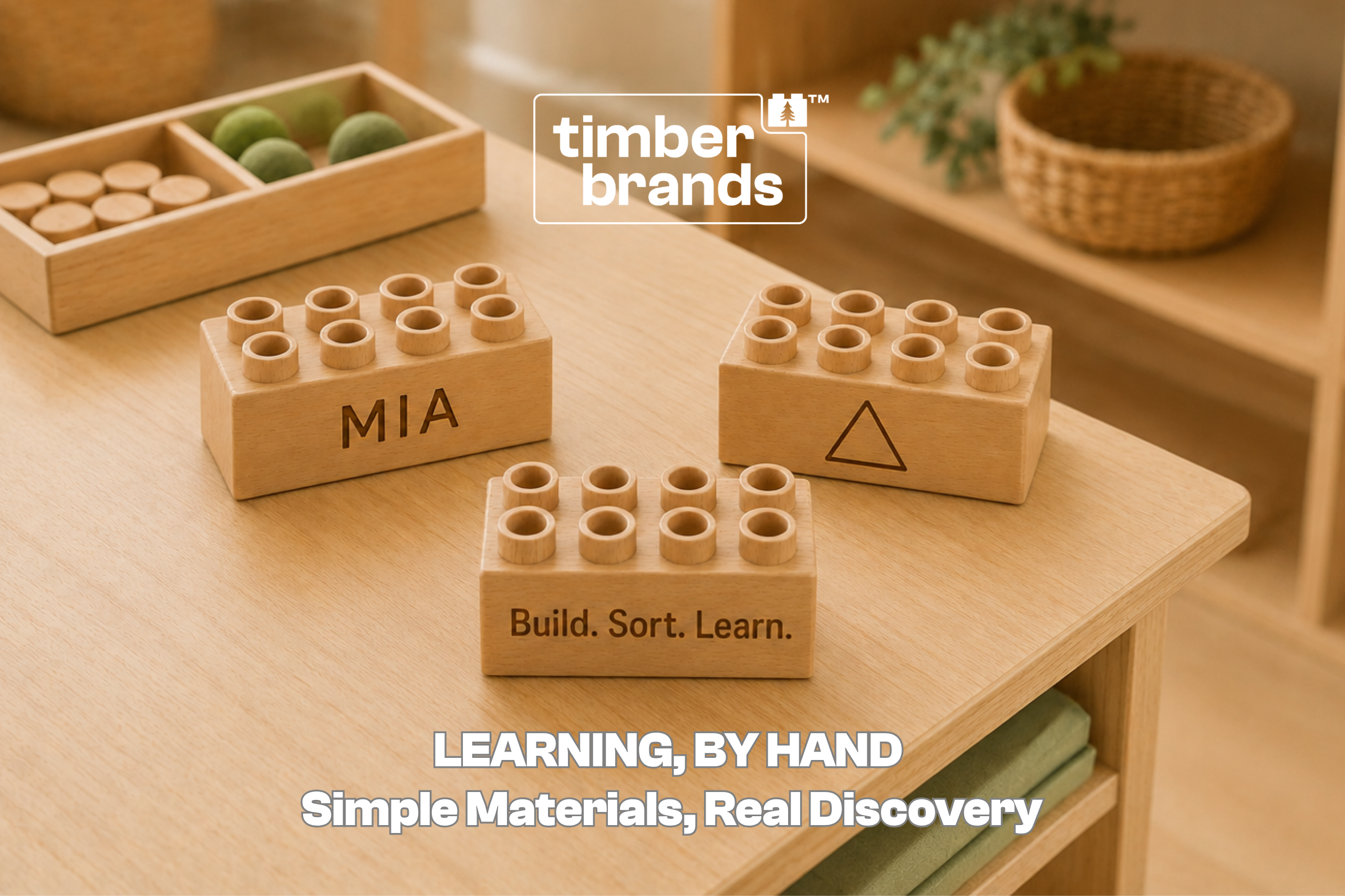
A child’s own name is often the first word they learn to read, and Montessori classrooms lean into that early. A brick engraved with a child’s name can mark a cubby, serve as a check-in piece moved at arrival, or simply be a personal object a child returns to and recognizes without help. Because the engraving is permanent, it holds up to the kind of daily handling that a laminated paper label rarely survives.
Small Cues That Support Independence
Much of what makes a Montessori classroom function is invisible to a visitor — a set of quiet visual cues that let children work without asking an adult what comes next. A brick labeled with a station name, engraved with a simple icon showing whether a space is in use, or marking a step in a daily routine gives children that same kind of independence in a physical, durable form.
Nature on the Shelf, Not Just on the Wall
Montessori classrooms often build nature study directly into the room, and wood fits that theme simply by being what it is. A set of bricks engraved with leaves, mountains, or seasonal icons can anchor a nature table without introducing anything synthetic into a space meant to feel grounded in the natural world.
Choosing the Right Size for the Right Hands
Brick size matters more in a Montessori classroom than almost anywhere else, since materials are so often used independently by very young children. Standard 2×4 Wooden Bricks, with their smaller solid studs, tend to suit older Primary and Elementary students who can manage finer motor tasks. Plus 2×2 and Plus 2×4 Wooden Bricks, with their larger hollow studs, are easier for toddlers and younger children to grip and stack on their own. Both sizes interlock with the plastic systems most classrooms already have.
A Material Worth Adding Slowly
Timber Brands demonstrates that a classroom material doesn’t need to be complicated to be genuinely useful. A single themed set and a small run of personalized name bricks is usually enough for a teacher to see how the material gets used before expanding further.
Create Your Montessori Classroom Set:
Explore Custom Engraved Wooden Bricks
Contact Us to Get Started: sales@timberbrandsusa.com
For Immediate Assistance Call: +1 214 326 0130
Every engraved brick gives a child something honest to build with.
Frequently Asked Questions
Are Timber Brands bricks Montessori-certified?
No. Timber Brands products are not officially Montessori-certified materials, but they’re designed around the same principles Montessori classrooms favor — natural materials, honest feedback, and open-ended use.
What size brick works best for younger children?
Plus 2×2 and Plus 2×4 Wooden Bricks have larger hollow studs, making them easier for toddlers and younger children to grip and stack independently. Standard 2×4 Wooden Bricks suit older students who can manage finer motor tasks.
Can wooden bricks be used with a classroom’s existing plastic bricks?
Yes. Both Standard and Plus-size Timber Bricks are compatible with leading plastic building systems, so they integrate directly into materials a classroom already has.
Can a child’s name be engraved on a brick?
Yes. A brick can be engraved with a child’s name for cubby labels, check-in pieces, or a personal object a child recognizes and returns to on their own.
What are some classroom uses for engraved bricks beyond building?
Engraved bricks can support sorting and sequencing, counting exercises, nature study displays, and quiet visual cues like station labels or routine markers.