Sight words and spelling become more interactive when students can physically arrange, connect, separate, and rebuild the letters and words they are learning.
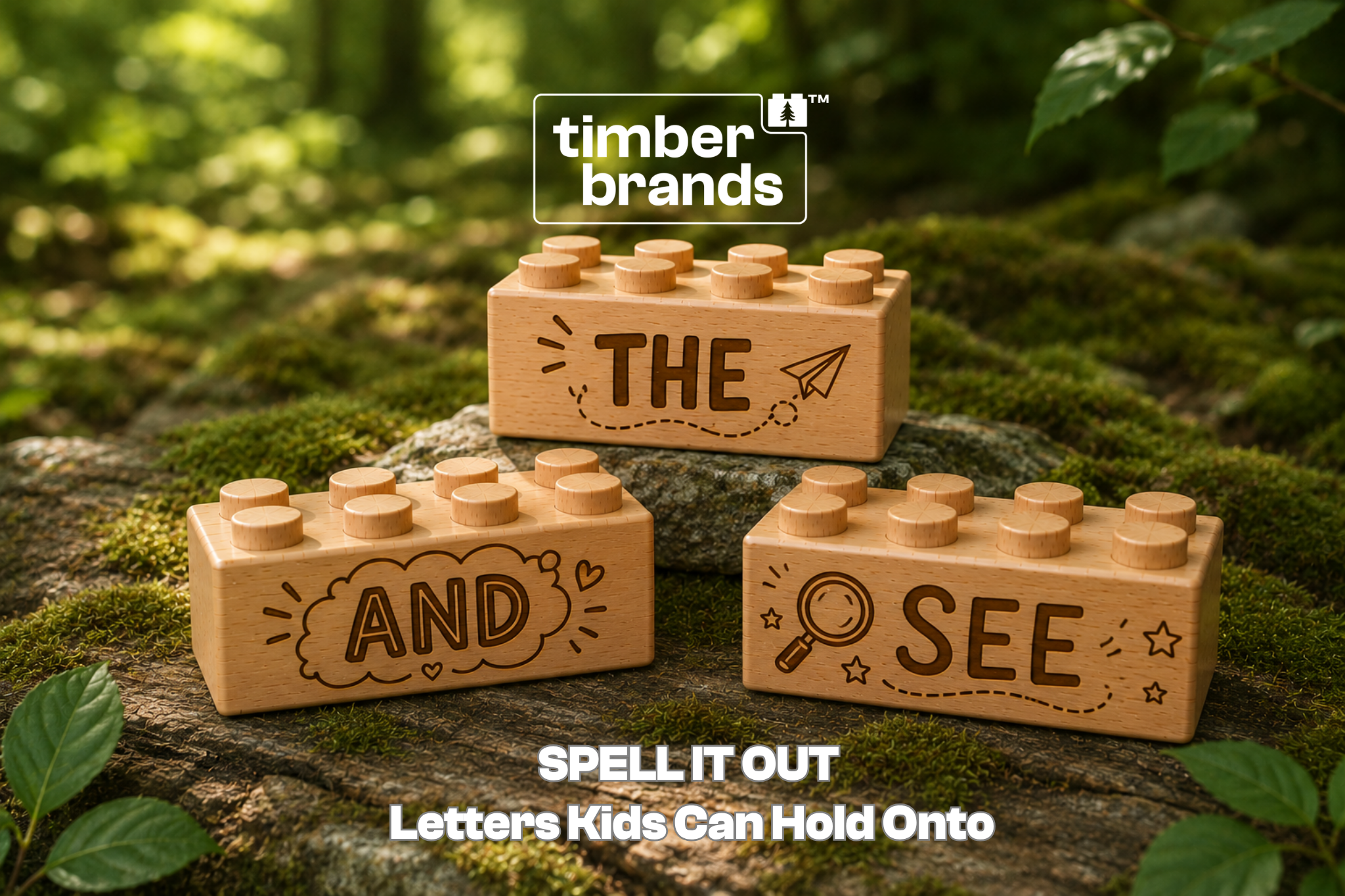
Timber Brands creates custom engraved wooden bricks for classroom literacy practice. Teachers can personalize the bricks with individual letters, common sight words, phonics patterns, spelling words, vocabulary terms, student names, or classroom themes.
Instead of viewing a word only on a worksheet or screen, students can pick up the letters, place them in sequence, compare patterns, and rebuild the word in a new activity. The same engraved set can support teacher-led lessons, small-group instruction, literacy stations, tutoring, and at-home practice.
Timber Brands products are precision milled from FSC-certified wood and permanently laser engraved in the United States. The broader product range includes Standard wooden bricks, larger Plus-Size formats, custom brick sets, and wooden baseplates that can support educational programs.
For educators looking for reusable sight-word and spelling activities, engraved building bricks provide a flexible tool that can grow with the classroom vocabulary.
Why Use Building Bricks for Sight-Word and Spelling Practice?
Building-brick literacy activities give students a physical way to work with language.
A student can move one letter to change cat into can, separate a word into beginning and ending sounds, or place several sight words in order to create a sentence. The word is no longer something the student only sees. It becomes something the student can construct and change.
These activities can also create a lower-pressure form of practice. A misspelled word does not require erasing an entire line. The student can move one brick, replace a letter, and try again.
Building materials should not replace direct reading instruction, phonics lessons, handwriting, or time spent reading connected text. Instead, they can provide another way for students to practice the words and patterns already being taught.
15 Building-Brick Literacy Activities at a Glance
| Activity | Primary skill | Best setting |
|---|---|---|
| Build the Sight Word | Automatic word recognition | Morning work or literacy stations |
| Letter-Sound Match | Letter and sound relationships | Early phonics groups |
| Missing-Letter Challenge | Spelling and sound analysis | Small-group instruction |
| Word Family Towers | Rhyming and spelling patterns | Phonics lessons |
| Mix It and Fix It | Letter order and self-correction | Partner or independent practice |
| Read, Build, Write | Reading, spelling, and handwriting | Daily literacy routine |
| Sight-Word Search and Build | Word recognition and movement | Classroom review |
| Word Ladders | Phoneme substitution | Guided phonics practice |
| Partner Dictation Build | Listening and spelling | Partner work |
| Sort by Spelling Pattern | Word analysis and categorization | Small groups |
| Build a Sentence | Sentence structure and sight words | Writing centers |
| Roll, Read, and Build | Repeated word practice | Independent stations |
| Memory Match and Build | Visual memory and word recognition | Partner games |
| Vocabulary Build Wall | Content-area vocabulary | Science, math, and social studies |
| Take-Home Word Kits | Family-supported review | Home practice |
1. Build the Sight Word
Select one word from the class sight-word list and ask students to build it with engraved letter bricks.
The teacher can show the complete word first, say it aloud, and use it in a sentence. Students then find the correct letters and place them in order. After reading the word, they can take it apart and rebuild it without looking at the model.
For a quicker activity, use a brick engraved with the complete word rather than one brick for every letter. Students can find the correct word from a small group, read it aloud, and connect it to a sentence, picture, or matching card.
This works well as morning work because the activity can focus on one word each day without requiring a new worksheet.
2. Match Letters to Their Sounds
Place engraved letter bricks beside picture cards or classroom objects. Students match each item with the letter representing its beginning sound.
A student might place B beside a book, P beside a pencil, or M beside a picture of the moon. As students advance, the same activity can focus on ending sounds, vowels, blends, or digraphs.
The teacher should ask the student to say both the object and sound aloud. This helps keep the activity focused on sound recognition rather than visual guessing.
Larger Plus-Size Wooden Bricks can make individual letters easier to see during teacher demonstrations or early-learning activities.
3. Complete the Missing-Letter Challenge
Build a familiar word but leave one letter missing. Students must identify the missing sound and select the correct brick.
For example, the teacher might present c_t, s_n, or _ake. The student says the word, isolates the missing sound, and places the correct letter into the space.
The challenge can be adjusted by offering two possible letters or allowing students to search through a larger collection. Beginning learners may work with short consonant-vowel-consonant words, while older students can complete words containing blends, vowel teams, or suffixes.
After the word is completed, ask the student to read it and use it in a sentence.
4. Build Word Family Towers
Word families help students notice that several words can share the same ending pattern.
Begin with a brick or connected group representing a word ending such as -at, -an, -ig, or -op. Students add a beginning letter to create a word, read it, and then replace that first letter to create another.
The -at family might become cat, hat, mat, and sat. Students can stack or arrange each completed word to create a word family tower or row.
As students progress, the activity can use more complex patterns such as -ake, -ight, -ain, or -ound.
The visual repetition helps students compare what stays the same and what changes from one word to the next.
5. Mix It and Fix It
Give students the correct letters for a word, but place them in the wrong order.
A student might receive t, h, e and rearrange the letters to build the. Another might receive p, l, a, y and construct play.
The activity can focus on sight words, spelling words, student names, vocabulary, or words from a current book.
When students need help, provide a clue such as the first letter, a spoken sentence, a picture, or the number of sounds in the word. The goal is to support problem-solving without immediately revealing the answer.
After building the correct word, the student should read it and explain what was changed.
6. Use a Read, Build, Write Routine
Read, Build, Write connects word recognition, letter arrangement, and handwriting in one repeatable activity.
First, the student reads a word shown by the teacher. Next, the student builds the word with engraved bricks. Finally, the student writes it on paper or a dry-erase board.
This routine gives the student several encounters with the same word. The child sees it, says it, constructs it, and writes it.
A literacy station can include a small word deck, the matching letter bricks, and a recording sheet. Students complete the steps independently while the teacher works with another group.
The same format can be used with sight words, phonics words, weekly spelling lists, or subject-specific vocabulary.
7. Create a Sight-Word Search and Build
Place several engraved word bricks around the classroom or within a designated literacy area.
Give students a word list or call out one word at a time. When a student finds the correct brick, the student reads it, brings it to the work area, and connects it to the class baseplate or word display.
This activity adds movement to literacy practice without changing the academic objective.
Teachers can also provide a sentence and ask students to locate the missing sight word. For example, “We went ___ the park” requires the student to find to.
A search-and-build activity works well for whole-class review, small groups, or a transition between seated lessons.
8. Create Word Ladders
A word ladder begins with one word and changes one sound or letter at a time to create a new word.
Students might change cat to cot, cot to dot, and dot to dog. At each step, they replace only the brick that needs to change.
The physical movement makes the substitution visible. Students can see that most of the word remains the same while one sound changes.
The teacher should select words that match the phonics patterns students already know. Beginning ladders can use short vowel words, while more advanced versions can include blends, vowel teams, prefixes, or suffixes.
Word ladders work best when students read every new word aloud before moving to the next step.
9. Try Partner Dictation Builds
Place students in pairs. One student reads a word from a teacher-prepared card, and the partner builds it without seeing the card.
The builder listens to the word, repeats it, identifies the sounds, and selects the correct letters. The partners then compare the completed word with the card.
Students can switch roles after every word or after a short group of words.
This activity gives students practice with careful listening and clear pronunciation. It also encourages them to ask useful questions such as, “Can you repeat the word?” or “Can you use it in a sentence?”
For sight words that cannot be spelled entirely through sound, the activity should use words students have already studied.
10. Sort Words by Spelling Pattern
Prepare engraved word bricks representing several spelling patterns. Students read the words and sort them into groups.
A phonics sort might compare words containing sh, ch, and th. Another activity could separate short and long vowel patterns. Older students might sort words by prefixes, suffixes, syllable patterns, or plural endings.
The groups can be organized on a wooden baseplate or beneath engraved category headings.
After sorting, students explain why each word belongs in its group. This explanation is important because it reveals whether the student recognized the spelling feature or sorted by appearance alone.
Students can finish by adding another word to each category.
11. Build a Sentence
Use engraved sight-word bricks and selected vocabulary words to create simple sentences.
Students arrange the bricks in the correct order, read the sentence aloud, and check whether it begins with a capital letter and ends with appropriate punctuation.
A younger student may build a sentence such as “I see the dog.” An older student might receive a group of words and arrange them into more than one meaningful sentence.
Teachers can also provide a sentence frame such as “I like ___” or “The ___ is ___.” Students complete the idea with a word brick and then copy the full sentence onto paper.
This activity helps connect isolated sight-word recognition to actual reading and writing.
12. Play Roll, Read, and Build
Create a numbered chart containing six sight words or spelling patterns. Students roll a number cube, read the corresponding word, and build it.
After completing the word, the student records it or uses it in a sentence. The activity continues for a set amount of time or until every word has been built.
The chart can be updated each week to match the current literacy lessons. Teachers can also use pictures, letters, word families, or vocabulary categories instead of complete words.
Because the structure of the game remains the same, students can learn the routine once and use it with new content throughout the year.
13. Play Memory Match and Build
Create pairs using engraved word bricks and matching cards. Place the materials face down or hide the word bricks beneath cups.
Students uncover two items at a time and try to match the printed word with the engraved brick. When a pair is found, the student reads the word and either keeps the pair or adds the brick to a shared structure.
Another version matches a word with a picture, definition, opposite, rhyming word, or sentence.
The activity should use a manageable number of pairs so students remain focused on reading rather than becoming overwhelmed by the search.
14. Build a Vocabulary Wall
Building bricks can support vocabulary instruction beyond the early sight-word list.
Engrave bricks with words from science, mathematics, social studies, literature, or a current classroom theme. Students add each new term to a shared baseplate or freestanding display after discussing its meaning.
Related words can be connected or placed near one another. A science unit might group habitat, adaptation, predator, and prey. A mathematics display could connect sum, difference, product, and quotient.
The class can revisit the display during lessons, writing assignments, and review sessions. Because the pieces can be moved, students can reorganize the vocabulary by category, sequence, meaning, or relationship.
15. Send Home a Small Word-Practice Kit
A small engraved set can extend literacy practice beyond the classroom.
The teacher may send home the week’s sight words, a group of letter bricks, or one word family. Families receive a short instruction card explaining how to read, build, mix, and rebuild the words.
A simple home routine might ask the student to read each word, hide it, build it from memory, and use it in a sentence.
The activity should remain brief and manageable. Families should not need specialized teaching knowledge or extra materials.
Reusable word kits can rotate among students throughout the year. Teachers should establish a simple system for checking the materials out, returning them, and confirming that every piece is included.
Which Sight Words Should Teachers Introduce First?
Teachers should follow the literacy curriculum and word sequence already used by their school or district.
Early instruction often begins with frequently encountered words that students need when reading simple sentences and decodable texts. Examples may include the, a, I, is, to, and, you, we, see, and like.
However, a word should not be selected only because it appears on a general internet list. The strongest sequence coordinates sight-word practice with the phonics patterns, books, and writing activities students are currently using.
Some high-frequency words can be decoded using patterns students already know. Others contain an irregular part that may need to be taught explicitly.
Engraved bricks can support either type. The teacher can draw attention to the regular sounds, identify the unexpected spelling, and then use the word in connected reading.
Should Teachers Use Letter Bricks or Complete Word Bricks?
Both formats serve different instructional purposes.
| Brick format | Best use |
|---|---|
| Individual letter bricks | Spelling, phoneme substitution, word ladders, missing-letter activities, and word families |
| Complete word bricks | Sight-word recognition, sentence building, vocabulary walls, sorting, and reading fluency practice |
| Mixed letter and word sets | Differentiated stations and multi-step literacy routines |
| Plus-Size letter bricks | Teacher demonstrations, younger learners, and activities requiring greater visibility |
| Standard letter bricks | Detailed spelling work, older students, and larger word collections |
Teachers may begin with larger letter bricks for early sound and letter activities, then introduce Standard bricks as students work with longer words and more detailed spelling patterns.
How Can the Activities Be Adjusted by Grade Level?
The same materials can support different levels of literacy instruction.
Prekindergarten and kindergarten activities may focus on recognizing letters, matching beginning sounds, building student names, and working with short high-frequency words. Teacher modeling and guided practice are especially important at this stage.
First-grade students can build short vowel words, word families, digraphs, common sight words, and simple sentences. They may also begin completing literacy stations with less direct support.
Second- and third-grade students can work with vowel teams, multisyllabic words, prefixes, suffixes, contractions, and content-area vocabulary. They can also explain spelling patterns and compare words more independently.
Older students may use engraved bricks for morphology, vocabulary, sentence construction, language learning, intervention, or review. The tactile format is not limited to one age, but the words and directions should match the learner.
How Do Building Bricks Work in a Literacy Station?
A successful literacy station should have one clear objective, a manageable number of materials, and a routine students already understand.
A station might include engraved bricks, a baseplate, six word cards, and one recording sheet. Students could complete a Read, Build, Write routine or sort the words by spelling pattern.
The teacher should demonstrate the activity before assigning it as independent work. Instructions can also be shown with simple photographs or numbered steps.
Materials should be stored by skill rather than mixed into one large container. Separate sets for letters, sight words, vowel patterns, and vocabulary make the station easier to use and reset.
How Many Engraved Bricks Does a Classroom Need?
The quantity depends on whether the materials will be used for demonstrations, small groups, pairs, or individual stations.
A teacher demonstration may need only one set. Partner activities require enough matching letters or words for several pairs to work at the same time. Independent stations may need separate trays so students do not spend most of the activity searching for pieces.
Before ordering, teachers should identify the first group of activities they plan to use. This helps determine whether the classroom needs individual letters, complete word bricks, repeated vowels and consonants, Plus-Size pieces, or baseplates.
A custom set can also include duplicate letters. Common letters such as e, a, s, t, and r may be needed more frequently than less common letters.
Can Custom Legos Be Used for Spelling Practice?
Some educators search for custom legos when they want personalized building pieces featuring letters, words, student names, or classroom vocabulary.
Timber Brands creates independent wooden building bricks rather than molded plastic pieces. The bricks can be permanently engraved with letters, sight words, spelling patterns, vocabulary, and other teacher-selected content.
Standard Wooden Bricks, Plus-Size Wooden Bricks, custom brick sets, and wooden baseplates allow educators to create a coordinated literacy system for their classroom.
Are Wooden Literacy Bricks Reusable?
Yes. Engraved wooden bricks can be used across different lessons and student groups when they are handled, stored, and cleaned according to the product guidance.
A letter set may support phonics instruction early in the year, spelling practice later, and vocabulary activities throughout the term. Complete word bricks can move between morning work, guided reading, literacy stations, intervention, and home-practice kits.
Permanent engraving helps keep the educational content visible without relying on paper labels or stickers.
Timber Brands products are precision milled and laser engraved through a U.S.-based manufacturing process.
Teachers should select brick sizes appropriate for the age and needs of their students and follow all applicable classroom safety and supervision requirements.
A Smarter Way to Build Literacy Skills
Effective literacy instruction gives students repeated opportunities to read, spell, write, compare, and use words in meaningful contexts.
Timber Brands custom engraved wooden bricks provide a reusable, hands-on tool for that practice. Individual letter bricks can support phonics and spelling. Complete word bricks can reinforce sight-word recognition and sentence building. Plus-Size Wooden Bricks can provide greater visibility for younger learners, while wooden baseplates can organize word sorts, vocabulary displays, and classroom stations.
The bricks do not replace strong instruction or meaningful reading. They give teachers another way to make practice active, visible, and adaptable.
Contact Us to Get Started: sales@timberbrandsusa.com
For Immediate Assistance Call: +1 214 326 0130
Every engraved brick helps a student spell their way toward more confident reading.
Frequently Asked Questions
What are building-brick sight-word activities?
Building-brick sight-word activities ask students to read, find, arrange, connect, or rebuild high-frequency words using engraved letter or word bricks.
Can building bricks help with spelling practice?
They can provide a hands-on way to practice letter order, word families, phonics patterns, missing letters, word ladders, and weekly spelling words.
Are complete word bricks or letter bricks better?
Letter bricks are better for constructing and changing words. Complete word bricks are useful for recognition, sentence building, sorting, and vocabulary displays. Many classrooms can use a combination.
Which brick size is best for younger learners?
Plus-Size bricks provide a larger format that may be easier to see and handle. Teachers should choose the format that fits the students, activity, and applicable age guidance.
Can teachers order custom classroom words?
Yes. Timber Brands can engrave teacher-selected letters, sight words, spelling patterns, vocabulary, student names, and other educational content, subject to design and production requirements.
Can engraved bricks be used in literacy stations?
Yes. They can support Read, Build, Write routines, word sorts, matching games, spelling challenges, sentence building, and other independent or small-group activities.
Are Timber Brands literacy bricks made in the United States?
Timber Brands products are precision milled and permanently laser engraved in the United States using CNC and laser manufacturing systems.