Math concepts can be easier to understand when students can physically build, separate, compare, and rearrange the quantities they are learning.
Building bricks give teachers a flexible math manipulative that can support everything from early counting to multiplication arrays, fractions, and place value. Students can connect physical models with spoken explanations, written numbers, and mathematical symbols.
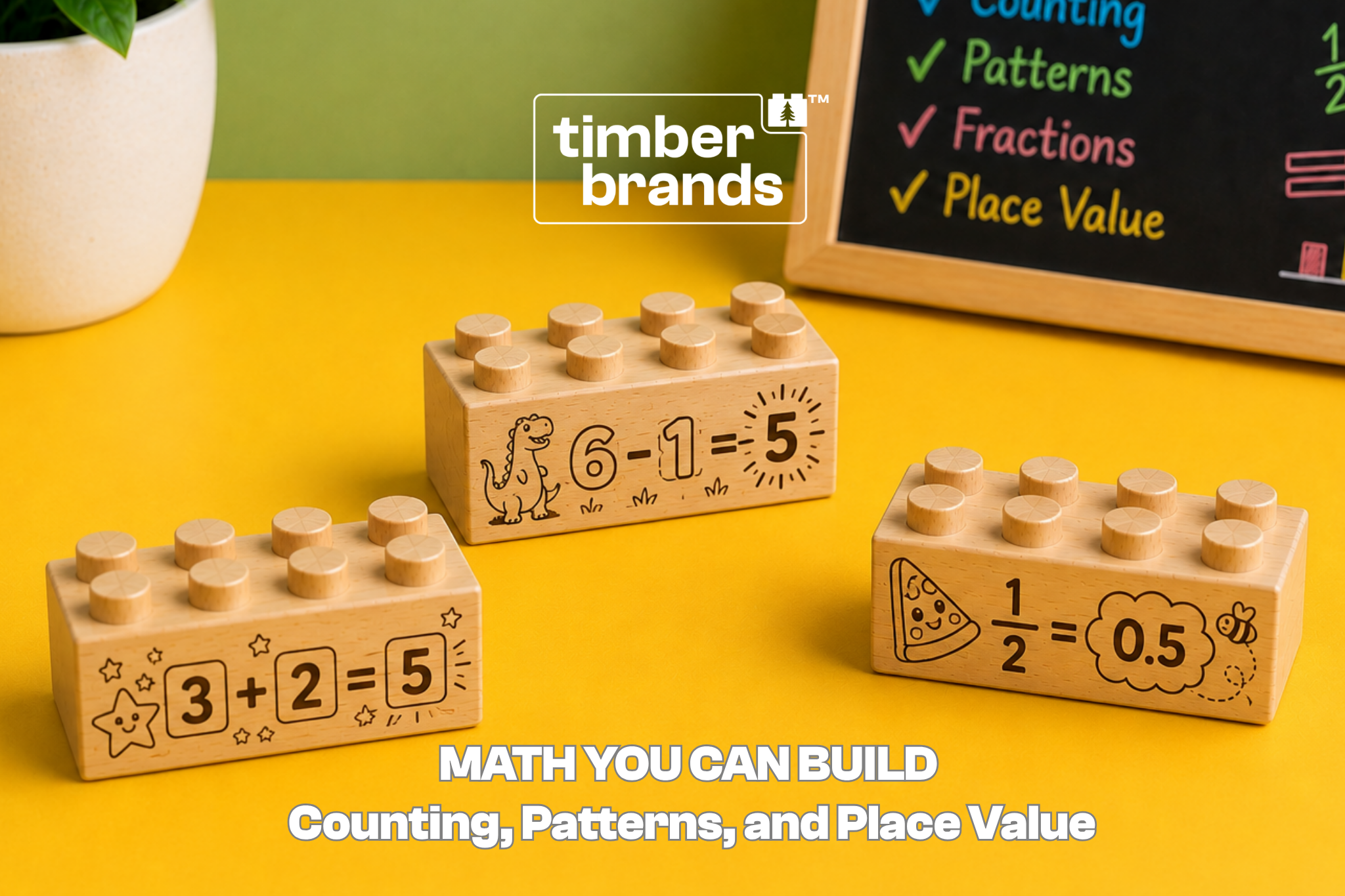
Timber Brands creates custom engraved wooden bricks for classrooms, tutoring programs, homeschool families, and educational organizations. Bricks can be personalized with numbers, operation symbols, fractions, shapes, place-value labels, equations, and teacher-selected math vocabulary.
Each Timber Brick is precision milled from FSC-certified wood and permanently laser engraved in the United States. The product range includes Standard wooden bricks, larger Plus-Size Wooden Bricks, custom sets, and wooden baseplates for organizing classroom activities.
For educators seeking reusable, hands-on math manipulatives, wooden building bricks provide a practical way to make abstract ideas more visible.
Why Do Building Bricks Work as Math Manipulatives?
Building bricks represent quantity in a form students can see and touch.
A tower of eight bricks is visibly larger than a tower of five. Two groups can be combined to model addition and separated to demonstrate subtraction. Studs arranged in equal rows can introduce arrays and multiplication.
Students can also revise their work easily. When a model is incorrect, they can remove a brick, regroup the pieces, and try again.
The strongest activities connect three parts of mathematical understanding:
- The student builds a physical model.
- The student explains what the model represents.
- The student records the idea using numbers and symbols.
Building bricks do not replace direct math instruction or written practice. They give students another way to explore and explain the concepts being taught.
Building-Brick Math Activities at a Glance
| Math concept | Building-brick activity | What students practice |
|---|---|---|
| Counting | Build a tower that matches an engraved numeral | One-to-one correspondence |
| Number comparison | Compare two rows or towers | Greater than, less than, and equal |
| Addition | Connect two groups and count the total | Combining quantities |
| Subtraction | Remove pieces from a larger group | Separating quantities |
| Patterns | Create and extend a sequence | Pattern recognition and prediction |
| Multiplication | Arrange bricks or studs in equal rows | Arrays and repeated addition |
| Fractions | Divide a defined model into equal parts | Part-to-whole relationships |
| Place value | Group units into ones, tens, and hundreds | Base-ten structure |
| Measurement | Measure objects using brick lengths or studs | Estimation and nonstandard units |
| Graphing | Stack bricks to represent survey results | Data organization and comparison |
How Can Building Bricks Teach Counting and Number Sense?
Counting activities begin by connecting one number word with one physical object.
A teacher can place engraved numeral bricks in a container and ask students to select one. The student then builds a tower containing the matching number of pieces.
For example, a student who selects the number 6 connects six bricks while counting each piece aloud.
After the model is complete, the teacher can ask:
- What is one more than six?
- What is one less?
- How many more are needed to make ten?
- Can you build six in two separate groups?
These questions help students move beyond memorizing the counting sequence and begin thinking about how numbers relate to one another.
Comparing Quantities
Students can build two towers and compare their height or length.
| Brick models | Mathematical relationship |
|---|---|
| Tower of 8 and tower of 5 | 8 > 5 |
| Row of 3 and row of 7 | 3 < 7 |
| Two towers containing 6 bricks | 6 = 6 |
Engraved comparison-symbol bricks can be placed between the models.
Students should also explain how many bricks must be added or removed to make the quantities equal. This connects comparison with early subtraction.
How Can Bricks Model Addition and Subtraction?
Addition can be introduced by creating two separate groups and connecting them.
A student might build a group of three bricks and another group of four. After counting both groups, the student joins them and determines the total.
The physical model can then be matched with the equation:
3 + 4 = 7
Subtraction reverses the process. The student begins with a complete quantity and removes a specified number of bricks.
A tower of nine bricks can be reduced by three:
9 − 3 = 6
Teachers can also ask students to build several combinations for the same total. The number eight could be represented as:
4 + 4
5 + 3
6 + 2
7 + 1
This helps students understand that the same number can be composed in different ways.
How Can Students Build and Extend Patterns?
Building bricks work well for repeating, growing, and number patterns.
Teachers can create sequences using engraved symbols, numbers, brick sizes, or orientation.
| Pattern type | Example |
|---|---|
| Repeating symbols | Star, circle, star, circle |
| Number pattern | 2, 4, 6, 8 |
| Alternating sizes | Standard, Plus-Size, Standard, Plus-Size |
| Orientation pattern | Horizontal, vertical, horizontal, vertical |
| Growing pattern | 1 brick, 2 bricks, 3 bricks, 4 bricks |
Students can begin by copying an existing pattern. They then extend it and explain the rule.
Growing patterns introduce early algebraic thinking because students must identify how the model changes from one stage to the next.
A teacher might ask, “How many bricks will the fifth stage need?” The student can use the pattern rule to predict the answer before building it.
How Can Building Bricks Introduce Multiplication?
Rows of studs create a natural visual model for multiplication arrays.
A Standard 2×4 Wooden Brick has eight studs arranged in two rows of four. Students can count each stud individually, count by rows, or use repeated addition.
The same brick can represent:
4 + 4 = 8
and:
2 × 4 = 8
Connecting multiple bricks creates larger arrays. Students can count the number of rows, determine how many units appear in each row, and write the matching multiplication equation.
For example, three rows containing four units each represent:
4 + 4 + 4 = 12
3 × 4 = 12
This helps students understand multiplication as equal groups rather than only a set of facts to memorize.
How Can Building Bricks Make Fractions Easier to Understand?
Fraction activities must begin with a clearly defined whole.
One simple model uses the eight stud positions on a Standard 2×4 brick as one complete group.
| Selected studs | Fraction of eight | Simplified fraction |
|---|---|---|
| 1 stud | 1/8 | 1/8 |
| 2 studs | 2/8 | 1/4 |
| 4 studs | 4/8 | 1/2 |
| 6 studs | 6/8 | 3/4 |
| 8 studs | 8/8 | 1 whole |
Before naming the fraction, the class should agree that all eight stud positions represent the whole.
Teachers can also use separate groups of bricks to model equivalent fractions:
4/8 = 2/4 = 1/2
Engraved fraction bricks can be placed beside each physical model, helping students connect the quantity with its written notation.
When comparing fractions, students should use models representing the same-sized whole. This prevents them from assuming that a physically larger object automatically represents the larger fraction.
How Can Building Bricks Teach Place Value?
Place value becomes more understandable when students physically group and exchange quantities.
A wooden baseplate can be organized into columns for ones, tens, hundreds, and thousands. Larger engraved bricks can label each position.
Students might use:
- One individual brick to represent one
- A connected group of ten to represent one ten
- Ten groups of ten to represent one hundred
For the number 243, the model would contain:
| Place | Quantity |
|---|---|
| Hundreds | 2 groups of one hundred |
| Tens | 4 groups of ten |
| Ones | 3 individual units |
The classroom must use one consistent representation so students always understand what each piece or group means.
How Does Regrouping Work with Building Bricks?
Regrouping can be modeled by exchanging ten individual units for one group of ten.
Students place individual bricks in the ones column. When the group reaches ten, those ten units are removed and replaced with one connected group in the tens column.
Subtraction works in reverse. When the ones column does not contain enough units, one group of ten is separated into ten individual pieces.
This activity helps explain the reasoning behind carrying and borrowing.
The quantity has not changed. It has only been reorganized into a different place-value form.
What Other Math Activities Can Teachers Create?
The same brick set can support several additional concepts.
Measurement and Estimation
Students can measure classroom objects using brick lengths or studs as nonstandard units.
Before measuring, the student estimates how many units the object will require. The bricks are then placed without gaps or overlaps to find the actual measurement.
This activity introduces the importance of using a consistent unit before students move to inches and centimeters.
Physical Bar Graphs
Each brick can represent one response in a class survey.
Suppose students vote for their favorite season. The bricks are stacked into labeled columns for spring, summer, fall, and winter.
Students can then identify:
- The most popular response
- The least popular response
- The difference between two categories
- The total number of votes
The physical graph can later be transferred to paper.
Area and Perimeter
Students can build a rectangular model and count the outer units to explore perimeter.
They can then count the rows and columns inside the rectangle to calculate area and connect the model with multiplication.
Number Bonds
A total can be divided into two smaller groups to demonstrate part-part-whole relationships.
A group of ten, for example, could be separated into six and four, seven and three, or eight and two.
Which Timber Brands Brick Size Is Best for Math?
The best size depends on the students, concept, and level of detail required.
| Timber Brands format | Recommended math use |
|---|---|
| Standard 2×4 Wooden Brick | Arrays, equations, fractions, patterns, graphing, and detailed work |
| Plus 2×2 Wooden Brick | Large numerals, symbols, shapes, counting, and younger learners |
| Plus 2×4 Wooden Brick | Place-value labels, larger equations, fraction labels, and classroom demonstrations |
| Custom Wooden Brick Set | Coordinated numbers, symbols, fractions, shapes, and learning activities |
| Wooden Baseplate | Place-value models, arrays, graphs, sorting, and math stations |
Plus-Size bricks provide a larger format that may be easier for younger students to see and handle. Standard bricks offer more detailed building possibilities for older students and advanced activities.
Standard Timber Brands bricks can also clutch onto the top of Plus-Size Timber Brands bricks. A larger Plus-Size brick can serve as a heading or foundation while smaller Standard bricks represent quantities, equations, or details above it.
Timber Brands’ product platform includes Standard bricks, Plus-Size formats, custom sets, and baseplates that can be adapted for educational use.
How Can Math Activities Be Adjusted by Grade Level?
Early learners can begin with counting, numeral matching, one more, one less, quantity comparison, shapes, and simple repeating patterns.
Kindergarten and first-grade students can build addition and subtraction models, number bonds, simple equations, and early place-value groups.
Second- and third-grade students can use the same materials for multiplication arrays, repeated addition, regrouping, fractions, measurement, and graphing.
Older elementary students can explore equivalent fractions, area, perimeter, factors, multiples, decimal place value, and multistep problems.
The bricks can remain the same while the mathematical questions become more advanced.
How Should a Building-Brick Math Station Be Organized?
A math station should focus on one clear objective.
The station might include engraved bricks, a baseplate, several task cards, and a recording sheet. Students could build a number, solve an equation, extend a pattern, or represent a fraction before writing the answer.
Materials should be organized by concept. Numerals, operation symbols, fractions, shapes, and place-value labels are easier to use when stored separately.
The teacher should demonstrate the routine before students work independently. A photograph or simple diagram can also show students how to reset the station.
Are Wooden Math Bricks Reusable?
Yes. Engraved wooden bricks can support multiple lessons, student groups, and grade levels when they are handled and stored according to product guidance.
A numeral set may begin with counting activities and later support addition, place value, graphing, and missing-number equations.
Permanent laser engraving keeps the educational information visible without relying on paper labels or stickers.
Educators should select brick sizes appropriate for their students and follow applicable school policies for age, cleaning, storage, safety, and supervision.
A Smarter Way to Build Math Understanding
Strong math instruction helps students connect physical quantities with spoken explanations, visual models, and written symbols.
Timber Brands custom engraved wooden bricks give students a reusable way to make those connections. They can count and compare pieces, build addition problems, create patterns, explore multiplication arrays, model fractions, organize place value, measure objects, and represent data.
Plus-Size Wooden Bricks offer greater visibility for early learners and teacher demonstrations. Standard bricks support more detailed activities, while wooden baseplates keep models, graphs, arrays, and learning stations organized.
The goal is not simply to build with bricks. It is to help students build a clearer understanding of the mathematics behind them.
Explore Math Learning Products:
Shop Custom Engraved Wooden Bricks
Explore Plus-Size Wooden Bricks
View Custom Wooden Brick Sets
Contact Us to Get Started: sales@timberbrandsusa.com
For Immediate Assistance Call: +1 214 326 0130
Every stack of bricks builds a little more number sense along the way.
Frequently Asked Questions
How can building bricks be used to teach math?
Students can use building bricks for counting, comparing quantities, addition, subtraction, patterns, multiplication arrays, fractions, place value, measurement, area, perimeter, and graphing.
Are building bricks useful as math manipulatives?
Yes. They provide a physical way to represent mathematical quantities and operations. They are most effective when students also explain the model and connect it to written numbers and symbols.
How can bricks teach fractions?
Teachers can define a complete brick or group as one whole and use studs or equal groups to represent parts. Students can then compare fractions and explore equivalent values.
How can building bricks teach place value?
Individual pieces can represent ones, while connected groups represent tens and hundreds. Students can demonstrate regrouping by exchanging ten individual units for one larger group.
Which brick size is best for younger learners?
Plus-Size bricks provide a larger format that may be easier to see and handle. Educators should follow the product-specific age and supervision guidance.
Can teachers order custom number and math bricks?
Yes. Timber Brands can engrave numerals, operation symbols, fractions, shapes, equations, place-value labels, patterns, and teacher-selected math vocabulary.
Can Standard and Plus-Size bricks be used together?
Yes. Standard Timber Brands bricks can clutch onto the top of Plus-Size Timber Brands bricks, allowing larger labels or foundations to support smaller math pieces above them.